
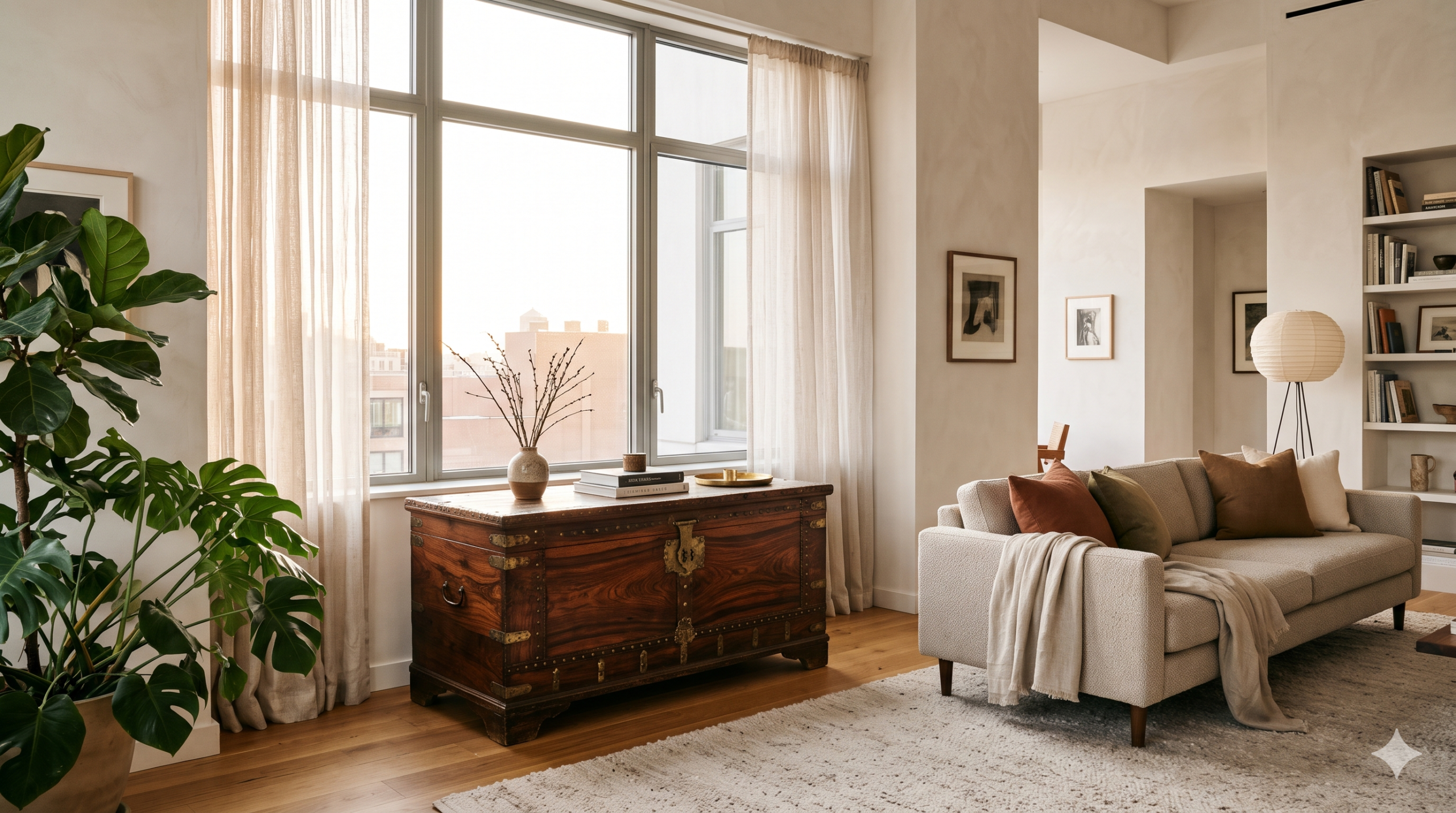
When Meera and Arjun moved into their new apartment in Whitefield, they had a problem.
The apartment itself was everything they wanted—floor-to-ceiling windows, clean white walls, an open plan that felt wonderfully modern and airy. But moving in from their old family home brought a dilemma.
Meera had brought her grandmother’s jhula (swing) and a massive, intricately carved rosewood chest. She loved them. They held her history.
But when the movers placed them in the bright, minimalist living room, it felt like a clash of two different worlds. The chest looked heavy against the sleek, modern sofas. The swing seemed to shrink under the high ceilings. Meera was worried that to keep her modern aesthetic, she would have to hide her heritage away in a spare bedroom.
We told her to stop hiding it.
The Problem with “Modern”
There is a reason why a room filled with only brand-new, factory-made furniture often feels a little hollow. It is beautiful, yes, but it has no memory. It doesn’t tell a story.
When we try to make a space look “perfectly modern,” we often strip away the very textures and layers that make a house feel like a home. But the answer isn’t to turn the living room into an antique shop, either. That just makes a space feel cluttered and heavy.
The real magic happens when you let the two worlds talk to each other.
Finding the Rhythm
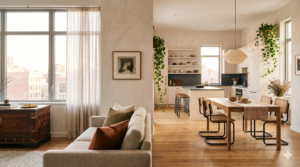
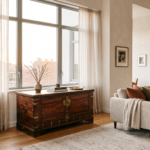
We started by looking at the rosewood chest. It had beautiful, deep grain lines and hand-carved brass details. Instead of pushing it against a wall, we made it the centerpiece of the room. We placed it on a warm, hand-woven jute rug, directly beneath the window. The natural light hits the wood and brings out its warmth.
Against the stark white walls, the chest suddenly didn’t look heavy. It looked like a piece of art.
Next came the swing. Hanging a traditional swing in a modern apartment can feel tricky. We changed the thick, heavy iron chains for sleek, minimalist steel cables that disappeared into the ceiling. We swapped the heavy wooden seat for a lighter teak piece, keeping the traditional carved arms but simplifying the base.
“Now, Meera’s swing didn’t look out of place. It looked like a custom, high-end installation.
The Rule of One
If you look around Meera’s living room today, it is mostly modern. There is a low-profile, light grey sofa. A glass coffee table. Simple, floor-to-ceiling sheer curtains.
But your eye is drawn immediately to the heirloom chest and the swing.
This is the principle we use in almost every home: Let craft be the punctuation mark, not the whole sentence.
When you pair one deeply traditional, handcrafted piece with a modern, neutral canvas, that piece gets to breathe. It commands attention because it isn’t competing with fifty other carved objects.
To make sure the room still felt contemporary, we added a modern brass floor lamp with clean, geometric lines next to the chest. The brass of the lamp echoed the brass handles of the chest, tying the old and new together.
It’s About Living, Not Just Looking
The final touch wasn’t something we bought. It was how the family used the space.
On our last visit, Arjun was sitting on the swing, reading a book on his tablet. Meera had placed a modern ceramic vase with fresh flowers on the old wooden chest. The space wasn’t a showroom anymore. It was a true home, where a family’s past and their present were living side by side.
What This Means for Your Home
You don’t have to choose between a modern life and honoring where you come from.
If you have a piece of fabric from your grandmother, frame it and hang it on a plain wall. If you have an old wooden door, use it as the headboard for a sleek, modern bed.
The beauty of Indian design isn’t just in building the new. It is in knowing how to carry the old forward.
If you have a piece you love but aren’t sure how to make it work in your new space, we would love to figure it out with you.


Customer Reviews
Nemo enim ipsam voluptatem quia voluptas sit aspernatur aut odit aut fugit, sed quia consequans magni dolores eos qui ratione voluptatem sequi nesciunt.
Nemo enim ipsam voluptatem quia voluptas sit aspernatur aut odit aut fugit
Nemo enim ipsam voluptatem quia voluptas sit aspernatur aut odit aut fugit, sed quia conse quans magni dolores eos qui ratione voluptatem sequi nesciunt.